
Technical SEO
Technical SEO for Healthcare Websites and Medical Schema
Technical SEO for healthcare is the work of making a medical website fast, secure and easy for search engines and AI tools to crawl, understand and trust. Arnaya Digital fixes the technical problems that hold practice websites back and adds medical schema markup that describes your practice, providers and services correctly.
Definition
What is technical SEO for healthcare?
Technical SEO for healthcare is the part of SEO that deals with how a medical website works rather than what it says: page speed, mobile use, crawling, indexing, site structure, security and structured data. Good content cannot rank if Google cannot crawl it, and patients leave a page that is slow on a phone.
Medical websites often have technical problems that other sites do not: old patient portal links, duplicate pages for each location, booking widgets that slow the page and PDFs that hold key information. Each one can cost rankings and patients.
The speed numbers Google uses
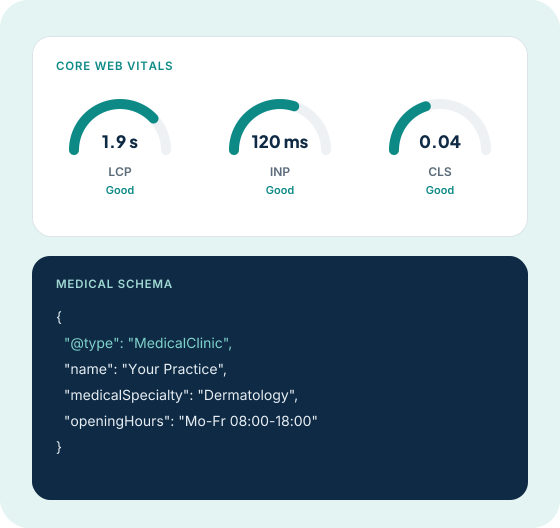
Google measures page experience with 3 Core Web Vitals, judged at the 75th percentile of real visits:
| Metric | What it measures | Good score |
|---|---|---|
| Largest Contentful Paint (LCP) | How fast the main content loads | 2.5 seconds or less |
| Interaction to Next Paint (INP) | How fast the page responds to a tap or click | 200 milliseconds or less |
| Cumulative Layout Shift (CLS) | How much the page moves while it loads | 0.1 or less |
We test every important page against these numbers and fix what fails, starting with the pages that bring the most patients.
Read the guide: Medical Website Speed. To turn more visits into bookings, see Conversion Rate Optimization.
What is included
Our technical SEO services for healthcare
01
Technical audit
A full crawl of your site to find broken pages, redirect chains, duplicate content, missing tags and indexing problems.
02
Speed and Core Web Vitals
Faster images, fonts and scripts, and lighter booking and chat widgets, so pages pass Google’s speed thresholds on phones.
03
Crawling and indexing
Clean sitemaps, correct robots rules and canonical tags, so Google indexes the pages that matter and skips the ones that do not.
04
Site structure
A clear structure for services, conditions, locations and providers, with internal links that pass authority to the pages that book.
05
Medical schema markup
Structured data for your practice, each location, each provider and each FAQ, written to match what the page shows.
06
Migrations and redesigns
Redirect maps and checks before and after a new website launches, so a redesign does not cost your rankings. See Website Migration SEO.
07
Security and accessibility
HTTPS, secure forms and accessibility fixes that help patients with disabilities use your site.
08
AI crawler access
Robots rules and firewall settings checked so AI search crawlers, such as OAI-SearchBot and PerplexityBot, can read your public pages.
Medical schema
Medical schema markup we use
Schema markup is code that describes a page to search engines in a fixed format. Google states that structured data must match the visible content of the page. We use these types for healthcare websites:
- MedicalClinic or MedicalOrganization for the practice and each location, with address, phone, hours and specialty.
- Physician for each doctor, with medical specialty and the location where they practice.
- Dentist, Optician or Hospital where those types fit better.
- FAQPage for question sections. Google shows FAQ rich results only for well-known government and health websites, but the markup still describes the page.
- BreadcrumbList and Organization with sameAs links, so the brand and its profiles connect.
Schema helps machines read a page correctly. It does not guarantee a rich result or an AI citation on its own.
Example
A Physician schema example
Here is a short example for a doctor’s page. We write the full version for each provider.
{
  "@context": "https://schema.org",
  "@type": "Physician",
  "name": "Dr. Jane Doe",
  "medicalSpecialty": "Dermatology",
  "worksFor": { "@type": "MedicalClinic", "name": "Example Dermatology" },
  "address": { "@type": "PostalAddress", "addressLocality": "Austin", "addressRegion": "TX" }
}
FAQ
Technical SEO for healthcare FAQ
Does page speed affect Google rankings for medical websites?
Yes. Page experience, including Core Web Vitals, is part of how Google ranks pages. Speed also affects patients, because a slow page on a phone loses visitors before it loads.
What schema markup should a medical practice use?
A medical practice should use MedicalClinic or MedicalOrganization for the practice, Physician for each doctor, FAQPage for question sections and BreadcrumbList for navigation.
Can a website redesign hurt SEO?
Yes. A redesign that changes URLs without redirects, removes content or slows the site can lose rankings. A redirect map and checks before launch prevent most of the loss.
Do booking widgets slow down a medical website?
Yes, often. Many booking and chat widgets load heavy scripts. Loading them only when needed, or after the main content, keeps the page fast.
How often should a healthcare website get a technical audit?
A healthcare website should get a full technical audit at least once a year and after every redesign, migration or major update.
Find the technical problems on your site
Get a free audit of your site speed, indexing, structure and schema, with the fixes listed in order of impact.