
Glossary
Healthcare SEO Glossary: 52 Terms Explained in Plain Words
This healthcare SEO glossary defines the 52 terms doctors, practice managers and marketing teams meet most often in SEO, local search, AI search, advertising and patient privacy. Each definition is short and written in plain words, with links to the pages that explain each topic in full.
Written by the Arnaya Digital team. Last updated October 30, 2026.
Basics
Core SEO terms
SEO (search engine optimization)
The work of improving a website and its online presence so it ranks higher in search results for the searches that matter to the business.
Healthcare SEO
SEO for doctors, medical practices and hospitals, with extra care for content accuracy, local search and patient privacy. See Healthcare SEO Guide.
Keyword
A word or phrase people type into a search engine, such as “dentist near me” or “knee replacement recovery”.
Search intent
The goal behind a search: to learn something, to compare options or to book care. Pages rank best when they match the intent.
SERP (search engine results page)
The page a search engine shows after a search, with ads, maps, AI answers and regular results.
Organic results
The unpaid results on a search results page, ranked by the search engine’s systems.
Backlink
A link from another website to yours. Links from trusted, relevant sites help pages rank. See Link Building & Digital PR.
Domain authority
A score from third-party SEO tools that estimates how strong a website’s links are. Google does not use these scores, but they help compare sites.
YMYL (Your Money or Your Life)
Google’s term for topics that can affect a person’s health, finances or safety. Health content is held to a higher standard.
E-E-A-T
Experience, expertise, authoritativeness and trust: the qualities Google’s quality raters look for in content, especially on YMYL topics. See E-E-A-T for Medical Websites.
Topical authority
The trust a website earns by covering a topic fully, with connected pages that answer every main question. See Topical Authority.
Local search
Local SEO terms
Local SEO
The work of ranking in Google Maps and local results near each office. See Local SEO for Healthcare.
Google Business Profile
The free Google listing that shows a practice’s name, address, hours, reviews and photos in Google Maps and local results.
Map pack
The group of local business listings with a map that Google shows near the top of many local searches.
NAP
Name, address and phone number. NAP should match exactly on your website, Google profile and every directory.
Citation
Any listing of your practice’s name, address and phone number on another site, such as a health directory or an insurance directory.
Primary category
The main category on a Google Business Profile, such as Dentist or Dermatologist. It is one of the strongest local ranking signals.
Relevance, distance and prominence
The 3 factors Google states it uses to rank local results: how well a listing matches the search, how far it is from the searcher and how well known the business is.
Service-area business
A business that serves clients at their location, such as home care or mobile IV therapy, and can hide its street address on Google.
Location page
A page on your website for one office, with its address, hours, services, doctors and directions.
AI search
AI search terms
AI SEO
The work of making a business visible, cited and described correctly in AI tools such as ChatGPT, Gemini, Perplexity and Google AI Overviews. See AI SEO Services.
AEO (answer engine optimization)
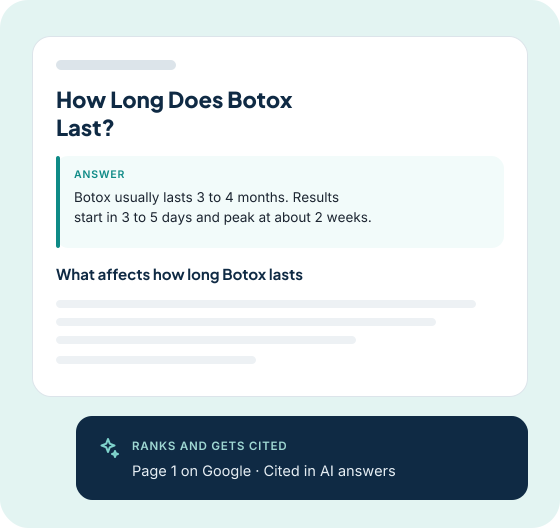
Writing and structuring content so search engines and AI tools use it as the direct answer to a question. See Answer Engine Optimization.
GEO (generative engine optimization)
Optimizing content so generative AI tools cite and name it in their answers. See Generative Engine Optimization.
Google AI Overviews
AI-written summaries at the top of many Google searches, with links to the pages they draw on. See Google AI Overviews.
AI Mode
A conversational search experience in Google Search that answers follow-up questions with AI.
LLM (large language model)
The type of AI model behind tools such as ChatGPT, Gemini and Claude. See LLM SEO.
Grounding
When an AI tool pulls current information from a search index at the moment of a question, to write a more accurate answer.
Query fan-out
A method where an AI search tool runs many related searches at once to answer one question.
Citation (AI)
A link to a source shown inside or beside an AI answer.
Entity
A distinct person, place, organization or concept that search engines recognize, such as a practice, a doctor or a treatment. See Entity SEO.
Knowledge Graph
Google’s database of entities and the facts that connect them.
AI visibility
How often and how accurately AI tools name, cite and describe a brand. See AI Search Visibility.
Technical
Technical SEO terms
Crawling
How search engines discover pages by following links and sitemaps.
Indexing
How search engines store pages so they can appear in results. A page that is not indexed cannot rank.
XML sitemap
A file that lists a website’s important pages for search engines.
Robots.txt
A file that tells search engine crawlers which parts of a website they may visit.
Schema markup
Code that describes a page to search engines, such as a practice’s address, a doctor’s specialty or a list of FAQs. See Technical SEO & Medical Schema.
Core Web Vitals
Google’s 3 measures of page experience: loading speed (LCP), response to taps (INP) and layout stability (CLS). See Medical Website Speed.
301 redirect
A permanent redirect that sends visitors and search engines from an old URL to a new one.
Website migration
Any change to a website’s URLs, platform, domain or structure that affects search. See Website Migration SEO.
WCAG
The Web Content Accessibility Guidelines, the standard for making websites usable by people with disabilities. See Healthcare Website Design.
Ads and measurement
Advertising and measurement terms
PPC (pay per click)
Advertising where the business pays each time someone clicks an ad, such as Google Ads. See Google Ads for Doctors.
Remarketing
Showing ads to people who visited your website before. Google and Meta limit remarketing for health conditions.
Conversion
An action that leads to an appointment, such as a call, a form request or an online booking.
Conversion rate
The share of visitors who complete a conversion. See Conversion Rate Optimization.
Call tracking
A system that traces each phone call to the search, ad or profile that brought it. See Call & Conversion Tracking.
Cost per appointment
The total ad cost divided by the number of booked appointments it brought.
Google Analytics 4 (GA4)
Google’s website analytics tool. Practices must not send it patient health information.
Privacy
Patient privacy terms
HIPAA
The Health Insurance Portability and Accountability Act, the US law that protects patients’ health information. See HIPAA & Privacy.
PHI (protected health information)
Health information that can identify a patient, such as a name linked to a condition, a visit or a bill.
BAA (Business Associate Agreement)
A contract in which a vendor agrees to protect PHI it handles for a healthcare provider.
Tracking pixel
A small piece of code from an ad or analytics platform that reports what visitors do on a website. See HIPAA-Compliant Analytics.
FAQ
Healthcare SEO glossary FAQ
What is the difference between SEO and local SEO?
SEO covers all search results. Local SEO focuses on Google Maps and local results near each office, using the Google Business Profile, reviews and location pages.
What is the difference between AEO and GEO?
AEO aims to make content the direct answer to a question. GEO aims to get content cited and named inside longer AI-written answers. Both rely on clear, sourced content.
Is E-E-A-T a Google ranking factor?
No, not as a single score. E-E-A-T describes what Google’s quality raters look for, and Google’s systems reward content that shows those qualities, especially on health topics.
Questions about any of these terms?
Get a free SEO audit. We explain what each term means for your practice, with a clear list of fixes.