
Healthcare SEO Guide
SEO for Healthcare: A Guide for Doctors, Medical Practices and Hospitals
SEO for healthcare is the work of making doctors, medical practices and hospitals appear in Google, Google Maps and AI answers when patients search for care. This guide explains how patients search, the 6 parts of healthcare SEO, what changes for doctors, practices and hospitals, the privacy rules that apply, how to measure results and a checklist to start with.
Written by the Arnaya Digital team. Last updated October 29, 2026.
Definition
What is healthcare SEO?
Healthcare SEO (search engine optimization for healthcare) is the work of improving a medical organization’s website, Google Business Profile, reviews and online reputation so it ranks for the searches patients make. The goal is more booked appointments from patients who need the organization’s care.
Healthcare SEO differs from SEO for other businesses in 3 ways:
- Higher standards for content. Google’s Search Quality Rater Guidelines call health a “Your Money or Your Life” (YMYL) topic, held to a higher standard of accuracy and trust.
- Local intent. Most patients look for care close to home or work, so Google Maps and local results matter more than in many other fields.
- Privacy rules. Reviews, forms and tracking must protect patient health information under HIPAA.
Why SEO matters in healthcare
SEO matters in healthcare because patients search before they book, and they choose from the few options they find first.
- AMN Healthcare’s 2025 survey of 15 large US cities found an average wait of 31 days for a physician appointment, up 19% since 2022. Patients who face long waits search for practices that can see them sooner.
- Google states that local results depend on 3 factors: relevance, distance and prominence.
- Pew Research Center found that people clicked a search result on 8% of visits when Google showed an AI summary, compared with 15% without one.
- BrightEdge found that 75.3% of healthcare AI Overview citations in September 2025 also ranked organically, compared with 54.5% across all industries.
A practice that ranks well is visible in classic search, in the map pack and in AI answers. A practice that does not rank is missing from all three.
Patient search
How patients search for a doctor
Patients search for care in 6 main ways. Each needs its own type of page or listing.
| Search type | Example | What wins it |
|---|---|---|
| Near me | “urgent care near me” | Google Business Profile, reviews, location pages |
| Specialty and place | “dermatologist in Brooklyn” | Location pages, local SEO, listings |
| Symptom or condition | “lower back pain that will not go away” | Condition pages and articles |
| Treatment | “knee replacement recovery time” | Treatment pages |
| Cost and insurance | “MRI cost without insurance” | Cost pages, insurance pages |
| Doctor name | “Dr. Patel cardiologist reviews” | Provider pages, practitioner profiles, reviews |
The first 2 types decide where a patient books. The others build trust earlier in the search and often lead to the first 2.
The 6 parts
The 6 parts of healthcare SEO
Healthcare SEO has 6 parts. Each one supports the others.

Technical SEO
A fast, secure website that search engines can crawl and index, with medical schema markup that describes the practice, providers and services.

Local SEO
A complete Google Business Profile, a page for each location and accurate listings, so the practice ranks in the map pack.

Content
Service, condition, provider and cost pages that answer patient questions accurately, written for patients and approved by clinicians.

Authority
Links and brand mentions from local, medical and news sites that show the practice is well known and trusted.

Reputation
A steady flow of patient reviews and safe replies that protect patient privacy.

AI search
Answer-first content, consistent details and AI crawler access, so AI tools can cite the practice.
By organization
SEO for doctors and physicians
SEO for doctors and physicians focuses on the individual: making a doctor easy to find by name, specialty and location, and easy to trust.
- Provider pages: a page for each doctor with training, board certification, years in practice, languages spoken, hospital affiliations and areas of focus.
- Practitioner profiles: Google allows public-facing practitioners, such as doctors, to have their own Google Business Profile. A solo doctor at a branded practice shares one profile named “[Practice]: [Doctor]”.
- Directory profiles: complete, matching profiles on Healthgrades, Vitals, WebMD, Zocdoc and specialty directories.
- Reviews: reviews that name the doctor help patients choose the right provider.
Read more: Google Business Profile for Doctors.
SEO for medical practices
SEO for medical practices focuses on the practice as a whole: its services, locations and the path to booking.
- Service pages: one page per main service or condition, with what to expect, cost or insurance and how to book.
- Location pages: one page per office with address, providers, hours, parking and directions.
- Booking path: a phone number and a booking button on every page, and online booking where possible.
- Tracking: calls, forms and bookings tracked by source, so the practice knows what brings patients.
Find the plan for your specialty on our industries page.
SEO for hospitals
SEO for hospitals and health systems adds scale and complexity. Hospital SEO focuses on 5 areas:
- Service lines: strong pages for each service line, such as cardiology, orthopedics, oncology and maternity, which compete with specialist practices and other hospitals.
- Find-a-doctor directory: a crawlable physician directory with a page for each physician, linked to service lines and locations.
- Locations and departments: Google allows public-facing hospital departments that operate as their own units to have their own Business Profiles, with names different from the main hospital.
- Site health at scale: large sites with thousands of pages need clean structure, fast pages and careful handling of old content, so search engines crawl what matters.
- Brand and news: a newsroom, research and community programs that earn mentions and links from trusted sources.
Hospitals also face more teams, more approvals and more legacy systems. Hospital SEO works best with one shared plan across marketing, IT and clinical leaders.
AI search
Healthcare SEO and AI search
AI tools, such as Google AI Overviews, Google AI Mode and ChatGPT, now answer many health questions directly. In healthcare, they lean heavily on sources that already rank and already show trust.
Three steps prepare a medical website for AI search:
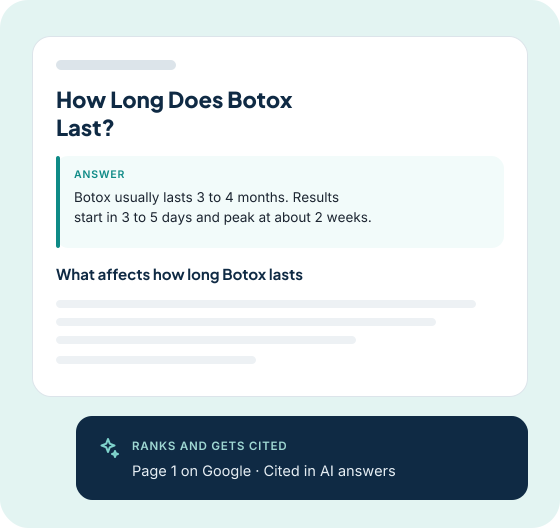
- Answer first. Put a clear answer of 40 to 60 words under each question heading.
- Keep facts consistent. Use the same hours, services, insurance and prices on every page and listing.
- Open access. Allow AI search crawlers, such as OAI-SearchBot and PerplexityBot, in robots.txt and your firewall.
Read more: What Is Answer Engine Optimization (AEO)? and How Patients Use ChatGPT to Find Doctors.
Privacy
HIPAA and healthcare SEO
Healthcare SEO must protect patient privacy at 3 points: review replies, tracking and forms.
Review replies
A reply can break HIPAA if it confirms that the reviewer is a patient or mentions their care. The US Department of Health and Human Services has settled several such cases. Manasa Health Center, a New Jersey psychiatric practice, agreed to pay $30,000 in 2023 after disclosing the health information of 4 patients in replies to Google reviews.
Tracking technologies
In December 2022, HHS issued guidance on the use of online tracking technologies by HIPAA-covered entities, and updated it in March 2024. In June 2024, a federal court ruled that part of that guidance went beyond HHS’s authority. The safe approach for a practice is simple: do not send information that reveals a patient’s condition, appointment or treatment to analytics or advertising platforms.
Forms
Contact and booking forms should ask only for what is needed, use secure connections and tell visitors not to include health details unless the form is built to protect them. See how we handle this in HIPAA & Patient Privacy.
These points are general information, not legal advice. Check your practice’s specific duties with a healthcare privacy professional.
Measurement
How to measure healthcare SEO
Healthcare SEO should be measured by patients, not only by rankings. Track these 6 KPIs each month:
| KPI | Where to find it | Why it matters |
|---|---|---|
| Booked appointments from organic search and Maps | Booking system, call tracking | The main outcome |
| Calls and direction requests | Google Business Profile performance | Local demand |
| No-show rate by source | Practice management system | Whether marketing brings patients who attend |
| Map pack rankings | Grid rank tracking | Local visibility across your area |
| Organic traffic to service pages | Google Analytics 4, Search Console | Interest in your services |
| AI citations and AI referral visits | Prompt testing, Google Analytics 4 | Visibility in AI answers |
A 2018 review of 105 studies in the journal Health Policy found an average no-show rate of about 23%. Tracking no-shows by source shows which channels bring patients who keep their appointments.
Checklist
Healthcare SEO checklist
Start with these 12 checks:
- The Google Business Profile is claimed, verified and complete for every location.
- The practice name, address and phone match on the website and every listing.
- Each main service has its own page with an answer-first opening.
- Each location has its own page.
- Each provider has a bio page with credentials.
- The website loads fast on a phone and passes Core Web Vitals.
- Medical schema markup matches what each page shows.
- Every patient gets a review request, and every reply is HIPAA-safe.
- Health pages name their sources and show a last-updated date.
- AI search crawlers can read the site.
- Calls, forms and bookings are tracked by source without health details.
- A monthly report shows appointments, not only rankings.
How long healthcare SEO takes and what it costs
Healthcare SEO usually shows first ranking changes in 3 to 6 months and steady patient growth in 6 to 12 months. Competitive specialties, big cities and new websites take longer.
Healthcare SEO commonly costs $1,500 to $7,500 per month for a single-location practice, and more for multi-location groups and hospitals. Read the full breakdown: How Much Does Healthcare SEO Cost?.
See all 60 checks: Healthcare SEO Checklist. Unsure about a term? See the Healthcare SEO Glossary.
FAQ
Healthcare SEO FAQ
Is SEO worth it for doctors?
Yes. SEO helps doctors reach patients who are already searching for their specialty nearby, and the patients it brings carry no cost per click.
What is the most important part of SEO for a medical practice?
For most practices, local SEO matters most, because patients choose nearby care. A complete Google Business Profile with strong reviews is the first priority.
Can a medical practice do SEO on its own?
Yes, for the basics. A practice can claim its Google Business Profile, ask for reviews and write service pages. Technical work, content at scale and AI search usually need specialist help.
Is hospital SEO different from practice SEO?
Yes. Hospital SEO covers many service lines, a large physician directory, departments and thousands of pages, so it needs more structure, coordination and technical work.
Does healthcare SEO help with AI search?
Yes. AI tools often retrieve pages that already rank, and in healthcare they lean on trusted sources. Good healthcare SEO is the base of AI visibility.
Get a free healthcare SEO audit
We review your rankings, Google Business Profile, website, reviews, competitors and AI visibility, and send a clear list of fixes.