
Answer engine optimization (AEO) is the practice of structuring content so AI assistants and search engines use it as the direct answer to a question and name your brand as the source. This guide explains what AEO means, how answer engines choose sources, how AEO differs from SEO and GEO, the 7 steps to do it and how to measure it.
AEO meaning
AEO stands for answer engine optimization. It is the practice of structuring content so AI assistants and search engines use it as the direct answer to a question and name your brand as the source. AEO applies to Google AI Overviews, ChatGPT, Perplexity and voice assistants.
An answer engine is a search tool that replies with a written answer instead of a list of links. The 3 most used answer engines are:
- Google AI Overviews and AI Mode: AI answers inside Google Search.
- ChatGPT search: web answers inside ChatGPT, with links to sources.
- Perplexity: an answer engine that cites its sources in every reply.
AEO aims for 2 results. A citation is a link to your page shown as a source for the answer. A mention is your brand name inside the answer text, with or without a link. A citation can bring a visit, and a mention builds recognition.
In marketing, AEO always means answer engine optimization. The same letters also stand for Authorized Economic Operator, a customs status, and they are the stock ticker of American Eagle Outfitters.
Why AEO matters now
AEO matters now because more searches end with an AI answer instead of a click. 4 numbers show the change:
- Pew Research Center tracked the searches of 900 US adults in 2025. Users clicked a result on 8% of visits with an AI summary, compared with 15% without one. Only 1% clicked a link inside the summary.
- Seer Interactive found that organic click-through rate fell 61% on queries with an AI Overview in its September 2025 update.
- The same Seer Interactive study found that brands cited in the AI Overview earned 35% higher organic click-through rate than brands that were not cited.
- OpenAI reported about 900 million weekly ChatGPT users in February 2026.
Fewer clicks reach the regular results. The brands named inside the answer keep a larger share of the clicks that remain.
How answer engines choose sources
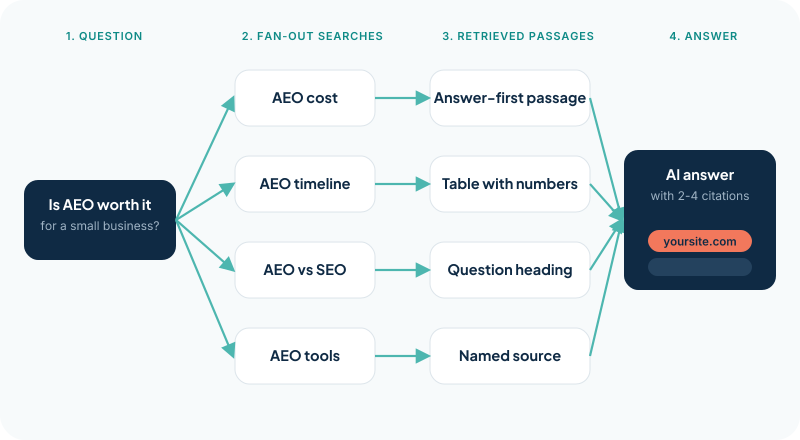
Answer engines choose sources in 3 stages: they search an index, they expand the question into related searches, and they lift short passages that answer each part.
Retrieval: answer engines search before they answer
Most answer engines search before they write. This method is called retrieval-augmented generation (RAG): the system retrieves relevant pages, then writes its answer from them. Google AI Overviews retrieve from the Google index. ChatGPT search uses OpenAI’s crawler, OAI-SearchBot, together with third-party search providers.
Ranking still matters, but it is not the only path. Ahrefs found in July 2025 that 76% of pages cited in AI Overviews also ranked in the top 10 for the same query. In its 2026 update, Ahrefs found 38%, and it noted that its method had improved between the two studies. BrightEdge found a higher overlap in healthcare: 75.3% of healthcare AI Overview citations in September 2025 also ranked organically.
Query fan-out: one question becomes many searches
Google states that AI Overviews and AI Mode may use a technique called query fan-out. Query fan-out means the system runs several related searches across subtopics before it writes the answer. For example, the question “is AEO worth it for a small business” can fan out into searches about AEO cost, AEO timelines, AEO vs SEO and AEO tools. A page that answers these sub-questions has more chances to be retrieved.
Passages: the unit that gets cited
Answer engines cite passages, not whole pages. A passage of 40 to 60 words directly under a question heading is easy for an answer engine to lift. Aggarwal and colleagues tested this in the GEO study presented at KDD 2024. On a benchmark of 10,000 queries, adding citations, quotations and statistics raised a source’s visibility in AI answers by up to 40%.
AEO vs SEO vs GEO
SEO ranks pages in search results, AEO makes a page the direct answer to a question, and GEO makes a brand cited and described correctly in longer AI responses.
| SEO | AEO | GEO | |
|---|---|---|---|
| Goal | Rank pages in search results | Be the direct answer to a question | Be cited and described correctly in longer AI answers |
| Where results appear | Google and Bing results, map pack | AI Overviews, featured snippets, voice assistants, ChatGPT answers | ChatGPT, Gemini, Perplexity, Claude, Google AI Mode |
| Main signals | Relevance, links, technical health, content quality | Answer-first passages, question headings, structured data, trust | Brand mentions, consistent brand facts, citable statistics, topic coverage |
| How to measure | Rankings, organic clicks, conversions | Citations per tracked question, featured snippets, AI referral visits | Share of AI answers that name the brand, accuracy of the description, AI referral visits |
The three overlap. AEO and GEO both start from SEO, because most answer engines retrieve from search indexes. Read the full comparison: GEO vs SEO vs AEO.
How to do answer engine optimization in 7 steps
Answer engine optimization takes 7 steps: find the questions, answer them first, structure the page, add structured data, build your brand entity, open your site to AI crawlers and measure the results.
1. Find the questions your customers ask
Start with real questions, not keywords alone. Collect them from 5 sources: Google’s People Also Ask box, the questions report in Ahrefs or Semrush, sales and front-desk calls, your site search and the follow-up questions ChatGPT suggests. Group the questions by intent. Give each main question its own page, and use the related questions as headings on that page.
2. Answer each question in the first 40 to 60 words
Put the exact answer first and the detail after it. Start a yes-or-no answer with Yes or No. Start a “how much” or “how long” answer with the number.
- Weak answer: “In today’s fast-changing digital world, many marketers are asking whether AEO and SEO are the same thing.”
- Strong answer: “No. SEO ranks pages in search results. AEO makes a page the direct answer inside AI tools and search features.”
The strong answer can be lifted as it stands. The weak answer cannot.
3. Use clear headings and short passages
Write one question per heading, and answer it in the paragraph directly below. Keep each paragraph to 3 sentences or fewer. Use numbered lists for steps and tables for comparisons. Keep every answer in plain HTML text. An answer inside an image or a script-loaded widget may not be read.
4. Add structured data
Structured data describes the page to machines in a fixed format. Use Article for guides, Organization with sameAs links for your brand, LocalBusiness or MedicalClinic for locations and FAQPage for question lists. Google states that no special schema is required to appear in AI Overviews or AI Mode. Google also requires structured data to match the visible text. Since August 2023, Google shows FAQ rich results only for well-known government and health websites. Structured data helps machines read a page correctly, but it does not guarantee a citation.
5. Build your brand entity and mentions
An entity is a thing that search engines recognize as one distinct person, place, brand or concept. Answer engines trust brands they can recognize. Ahrefs studied 75,000 brands in May 2025. Branded web mentions showed the strongest correlation with AI Overview visibility, at 0.664. Backlinks showed a correlation of 0.218. A correlation does not prove cause, but the pattern is clear: brands that are talked about get named.
To build your entity:
- Use the same brand name, description, address and founder name on your website, LinkedIn, Google Business Profile and directories.
- Add a Wikidata entry if your brand meets its notability rules.
- Earn mentions in industry “best of” lists, local news, podcasts and partner websites.
6. Let AI crawlers read your site
An answer engine cannot cite a page that its crawler cannot read. Each AI company uses separate crawlers for search and for training:
- OpenAI: OAI-SearchBot decides whether pages appear in ChatGPT search. GPTBot collects content for model training. OpenAI states that each setting is independent, so a site can block GPTBot and still allow OAI-SearchBot.
- Google: AI Overviews and AI Mode use the normal Googlebot. The Google-Extended token controls use of content for Gemini models and does not affect Google Search.
- Perplexity: PerplexityBot crawls pages for Perplexity answers.
- Anthropic: ClaudeBot collects training content, and Claude-SearchBot crawls for search answers in Claude.
A robots.txt that allows AI search but blocks model training looks like this:
User-agent: OAI-SearchBot
Allow: /

User-agent: PerplexityBot
Allow: /

User-agent: Claude-SearchBot
Allow: /

User-agent: GPTBot
Disallow: /
Check your CDN or firewall as well. Cloudflare began blocking AI crawlers by default for new domains in July 2025, so a site can block AI search without anyone on the team knowing.
llms.txt is a proposed text file that lists a site’s key pages for language models. Google states that you do not need new machine-readable files or AI text files to appear in AI Overviews or AI Mode. Treat llms.txt as optional, not as a ranking factor.
7. Measure, then update
AEO is measured in 3 ways: a prompt panel, AI referral traffic in Google Analytics 4 and a Looker Studio dashboard that joins the two.
- Build a prompt panel. List 20 to 50 questions your customers ask. Each month, ask them in ChatGPT, Perplexity and Google AI Mode. Record whether your brand is cited, whether it is mentioned and whether the description is correct.
- Calculate citation share. Citation share is the number of answers that cite your brand divided by the number of questions tracked. Track it monthly for your brand and your top 3 competitors.
- Track AI referral traffic in GA4. Create a custom channel group called “AI assistants”. Set the rule to session source matching the regex below, and place the channel above Referral so GA4 applies it first.
chatgpt\.com|perplexity\.ai|gemini\.google\.com|copilot\.microsoft\.com|claude\.aiChatGPT adds utm_source=chatgpt.com to many of the links it shows, so most ChatGPT visits are easy to see. Some AI visits still arrive without a referrer and appear as Direct traffic.
Then join the data in Looker Studio. Connect GA4 for AI sessions, landing pages and conversions, and connect a Google Sheet for the prompt panel results. One dashboard then shows citation share next to the visits and leads it brings. Finally, update the pages that lose citations: rewrite the opening answer, add a current statistic with its source and update the date.
To track this across all AI tools, see AI Search Visibility.
AEO for healthcare and other regulated industries
AEO in healthcare and other regulated industries needs more proof than AEO in other fields. Google’s Search Quality Rater Guidelines call topics that can affect a person’s health, money or safety “Your Money or Your Life” (YMYL). Answer engines are more careful with these topics. BrightEdge found that 75.3% of healthcare AI Overview citations also ranked organically, compared with 54.5% across all industries. In healthcare, answer engines lean more heavily on pages that already rank and already earn trust.
4 rules make healthcare content citable:
- Name the expert. Show the author or the clinician who approves the page, with credentials.
- Keep facts consistent. Hours, insurance accepted, services and prices must match on every page and every listing.
- Name sources and dates. Name the study or guideline before the number, and show when the page was last updated.
- Protect patient privacy. Never send patient health details to analytics or advertising tools. The US Department of Health and Human Services has issued guidance on tracking technologies for HIPAA-covered entities.
Here is an example. A patient asks an answer engine, “Is urgent care cheaper than the ER?” An urgent care clinic can answer under that exact heading: “Yes. An urgent care visit usually costs less than an emergency room visit for the same minor illness or injury.” The next sentences list the clinic’s self-pay prices, the conditions it treats and when a patient should go to the ER instead. That passage is short, direct and safe to cite.
For the full picture of search in healthcare, read the Healthcare SEO Guide.
How long AEO takes and what it costs
AEO takes weeks for pages that already rank and months for new websites. Answer engines re-crawl pages that already rank often, so an answer-first rewrite can be picked up quickly. A new website must first earn rankings and brand mentions, which usually takes several months. No one can promise a citation, because each answer engine changes its sources over time.
AEO costs about the same kind of money as SEO, because most of the work is content, technical fixes and brand mentions. A team that already writes answer-first content can start with time and an AI visibility tracking tool. An agency is worth it when you need strategy, technical work and measurement across many pages. Arnaya Digital prices AEO work as a custom quote after a free AI visibility check, because every website starts from a different point. See our answer engine optimization services.
Answer engine optimization FAQ
Does AEO mean writing shorter content?
No. AEO means putting a short, exact answer at the start of each section. The full page can stay long and detailed below each answer.
Is AEO the same as GEO?
No. AEO focuses on being the direct answer to a question. GEO, or generative engine optimization, focuses on being cited and described correctly inside longer AI-generated responses.
Does schema markup guarantee an AI citation?
No. Schema markup helps answer engines read a page correctly. Citations depend mainly on whether the page ranks, answers the question directly and comes from a trusted source.
Can AEO bring value without a click?
Yes. An AI answer that names your brand builds awareness and trust. It often leads to a later branded search or a direct visit to your website.
Do I need an AEO agency?
No, not always. A team that already writes answer-first content and tracks AI referrals can start alone. An agency helps when you need strategy, technical work and measurement across many pages.